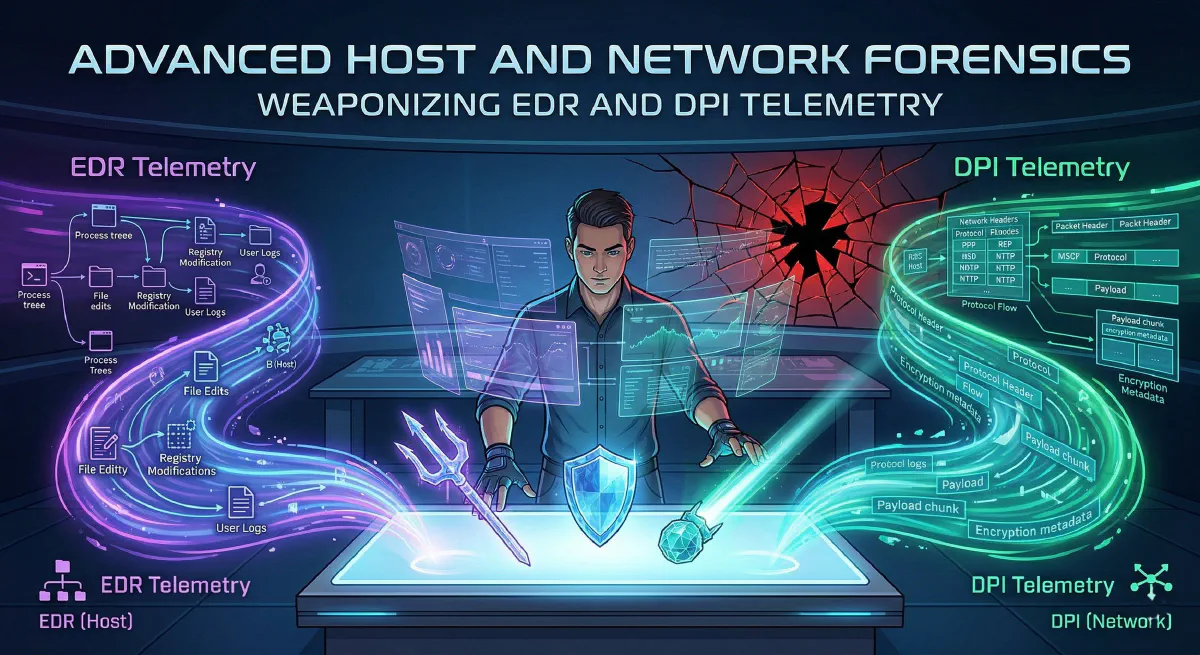
Executive Summary
In the modern threat landscape, sophisticated adversaries thrive in the gaps between traditional security controls. They pivot laterally across host systems and encrypt their communications, moving silently past siloed defenses. While Security Operations Centers (SOCs) are often drowning in alerts, they are frequently starving for context.
The current approach is unsustainable. We cannot secure modern architecture by snapshotting disconnected cells. We need to integrate our tactical visibility. This is where Advanced Host and Network Forensics—the potent unification of EDR and DPI telemetry—transform defenses from reactive monitoring to proactive weaponization.
The Bottleneck: Siloed Data, DisconnectedContext
Manual, isolated investigations are dead. The most critical friction point in current incident response is the manual “swivel” between host forensics (EDR/logs) and network traffic analysis (DPI).
| Forensic Pillar | Operational Visibility | Tactical Limitation |
|---|---|---|
| Endpoint Detection and Response (EDR) | Process execution (image_30.png), file modifications, registry tweaks, API calls. | Loses visibility the moment the process initiates a network connection. Has limited context on the content of the data exfiltrated. |
| Deep Packet Inspection (DPI) | L7 application data, protocol flow analysis, encrypted traffic metadata. | Loses visibility into which exact user or process initiated the connection on the host. Has limited context on the malware or exploit code. |
Attackers exploit this operational gap. An advanced adversary moves laterally across flat network segments, establishing island beachheads (Container/Analyze) and tunneling malicious traffic inside standard, encrypted protocols like HTTPS or DNS.
By moving protection away from the network perimeter and enforcing policies on identity, context, and continuous verification—the core tenets of Zero-Trust (ZTA) and micro-segmentation (image_1.png)—we can engineered to be impossible by design for attackers to move unhindered. We slashes attack impact and mitigates complex compliance friction. This duo of host and network visibility phase by phase forces compliance by design.
Synthesizing the Threat Narrative: How We Weaponize Telemetry
“Weaponizing” telemetry means moving beyond detection and into automated containment. This dynamic transformation (image_2.png) relies on the automated integration loop within the SIEM/SOAR/IdP stack. Here is how we operationalize advanced forensics (Process/Containment):
Phase 1: Contextualize and Shift Left (Discover)
Detection engineering begins with visibility. GRC teams maintain the risk register, which identifies the critical protect surfaces (Critical Assets). We must unify lower step telemetry above our CSP silos. Operational ZTA requires adopting identity-based, dynamic policies that scale (image_1.png). Federated IdP and workload identity tools (like SPIFFE/SPIRE) must issue short-lived, verifiable X.509 certificates for authentication between services (mTLS), on-prem or multi-cloud.
Phase 2: Orchestrated Fusion and Alert Gating (Analyze)
Zero Trust is built on “Never Trust, Always Verify.” This is the core “Triage/Analyze” phase (image_1.png). Your Policy Engine must ingest enterprise telemetry (SIEM, IDP, CDM, EDR) to make intelligence access decisions. When a process initiates suspicious network activity, we apply the duo:
EDR Host Context: process_name: powershell.exe, user_id: adm_jdoe, cmdline_arguments: -Enc ..., target_ip: 10.5.2.100
DPI Network Context: target_ip: 10.5.2.100, protocol: HTTPS, application: Dropbox, volume_outbound: 2.5GB, behavior: unusual_exfiltration_pattern
This transformation from reactive detection to proactive response reduces complex compliance friction. A phished credential cannot move 2.5GB without adaptive MFA step-up authentication.
Phase 3: Containment, Eradication, and Recovery
Zero-Trust continues even after an attack. If the alert gates identify a high-risk scenario, the Policy Engine triggers automated actions to create a transient access rule (Containment/Preparation) and execute repetitive containment actions automatically (Eradication/Containment). For higher-risk actions, this must include a “human-in-the-loop” approval workflow.
Operational Workflow:
- Automatically revoke mTLS certificates at the end of the JIT window. Initiate a full scan on those machines.
- Update playbooks to disable compromised user accounts and block business-critical traffic in IAM automatically. If the exception expires on Day 30, on Day 31, the playbook automatically blocks traffic and isolates the host, trapped within a single, tiny micro-segment boundary.
This transformation slashes attack impact and moves you toward a resilient cellular architecture where engineering an vulnerable state is impossible by design. It forces compliance by design.
Survival of the Fittest
Advanced forensics is not about deployment; it is about automation. Attackers operate with code-level speed; defensive response dependent purely on human intervention can no longer keep pace. By combining the unmatched visibility of EDR with the depth of DPI and integrating that duo into your automated response stack (SIEM/SOAR/IdP, as seen in image_2.png), you empower your SOC to fight code with code. This consolidation from reactive monitoring to proactive containment reduces attack impact, simplify complex compliance, and gives your analysts the time they need to focus on strategic defense—proving it continuously to auditors.
About the Author Sam Jobes, CISA-CISSP, is a 20-year information security veteran specializing in enterprise security architecture, GRC automation, and building scalable infosec programs for high-growth technology companies.