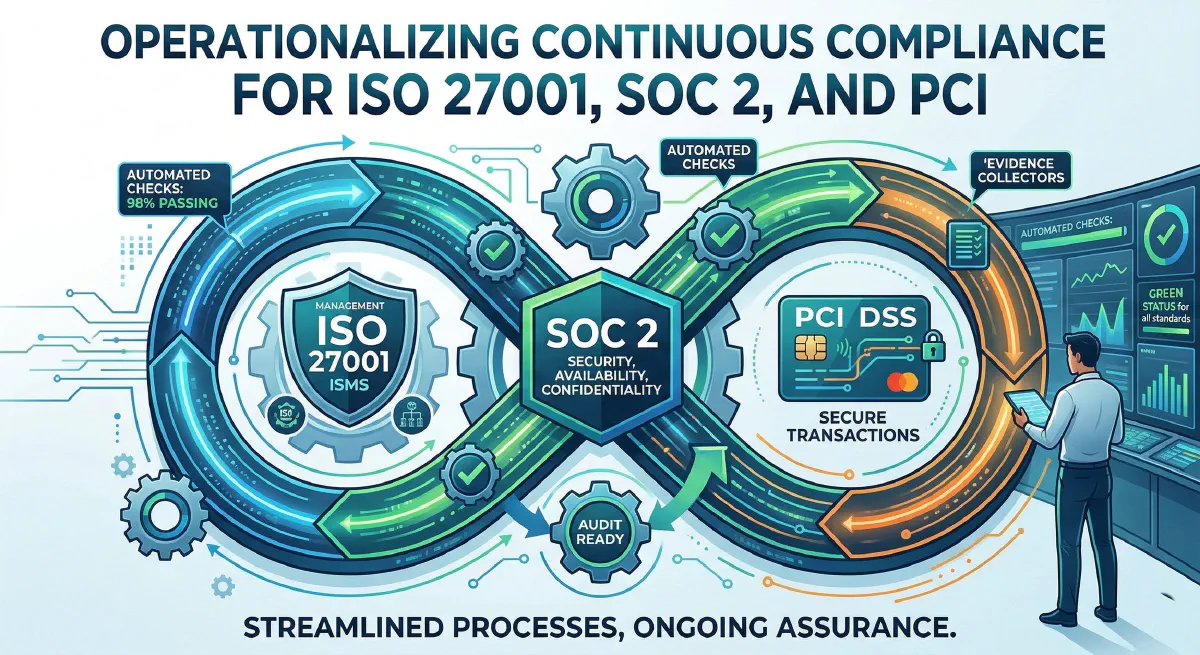
Executive Summary: Operationalizing Continuous Compliance for ISO 27001, SOC 2, and PCI
A strategic shift from point-in-time audits to an automated, continuous compliance model for 2026 and beyond, addressing the demands of modern cloud infrastructure and stringent regulatory frameworks.
This document outlines a strategic shift from traditional, point-in-time compliance audits to an “operationalized continuous compliance” model, essential for organizations in 2026 due to the rapid pace of cloud deployments, ephemeral infrastructure, and stringent demands of modern frameworks like PCI DSS v4.0.1 and ISO 27001:2022. The goal is to build a unified, automated, and continuous compliance engine that satisfies ISO 27001, SOC 2, and PCI DSS.
The Compliance Trifecta: Understanding Overlap and Differences
While the “Big Three” compliance frameworks share significant overlap (up to 70% in areas like access control, cryptography, and vulnerability management), their core philosophies differ:
- ISO 27001:2022 (with Amendment 1:2024): Focuses on process and risk management through an Information Security Management System (ISMS). It requires identifying risks, applying Annex A controls, and continuous improvement. Auditors are strictly enforcing the updated 93 controls and the 2024 climate change amendment.
- SOC 2 (Type II): Evaluates the design and operating effectiveness of controls over a specific period (6-12 months) based on AICPA Trust Services Criteria (TSC). It emphasizes proving consistent execution of claimed practices.
- PCI DSS v4.0.1: Highly prescriptive and binary, focusing on meeting technical control requirements within the Cardholder Data Environment (CDE). As of 2025, all “future-dated” requirements are mandatory, including continuous authenticated vulnerability scanning, customized approaches, and automated protections against e-commerce skimming.
A Unified Control Framework (UCF) is proposed to map these frameworks, allowing a single internal control to satisfy requirements across multiple standards (e.g., database encryption for ISO 27001, SOC 2, and PCI DSS).
Core Pillars of Continuous Compliance Architecture
Treating compliance as an engineering problem requires a robust architecture:
- Unified Control Framework (UCF): Acts as a translation layer, defines baseline controls, maps them to framework requirements, and enables dynamic evidence querying.
- Event-Driven Evidence Collection (The Evidence Pipeline): Replaces manual gathering with API-driven telemetry from CSPM, CNAPP, and IGA tools, continuously ingesting state data (from cloud infrastructure, version control, and device management) into a central GRC platform.
- Automated Drift Detection & Remediation: Continuously monitors for configuration changes that violate baseline controls, generating immediate alerts and, in mature systems, enabling auto-remediation to revert non-compliant changes.
Operationalizing the Day-to-Day
Technology alone is insufficient; integrating security into daily team habits is crucial:
- Shift-Left Compliance (Compliance as Code): Embeds compliance checks into IaC templates (Terraform, CloudFormation) using tools like Checkov or OPA within CI/CD pipelines to prevent non-compliant deployments.
- Identity & Access Governance: Utilizes Just-In-Time (JIT) access to eliminate standing privileges and automates User Access Reviews (UARs) by integrating HRIS with Identity Providers.
- Vendor & Third-Party Risk Management: Moves beyond annual questionnaires to continuous vendor monitoring platforms, ingesting SOC 2 reports and tracking security posture scores dynamically.
Navigating Framework-Specific Nuances in 2026
While a unified approach is powerful, specific framework details matter:
- ISO 27001: Requires demonstrating the “Plan-Do-Check-Act” (PDCA) cycle, operationalizing ISMS metrics for management reviews, and addressing the 2024 climate change amendment.
- SOC 2: Focuses on sustained operating effectiveness, mandating strict SLAs on control failure remediation.
- PCI DSS v4.0.1: Emphasizes flawless CDE scoping, continuous asset discovery, and operationalizing Targeted Risk Analysis (TRA) with threat intelligence.
Conclusion
The era of seasonal, manual compliance is over. By implementing a Unified Control Framework, API-driven evidence collection, and continuous drift detection, organizations can transform compliance into a proactive business enabler. This approach allows engineering teams to focus on feature development, provides real-time risk visibility to the board, and demonstrates to customers that security is deeply integrated into operations.
About the Author Sam Jobes, CISA-CISSP, is a 20-year information security veteran specializing in enterprise security architecture, GRC automation, and building scalable infosec programs for high-growth technology companies.