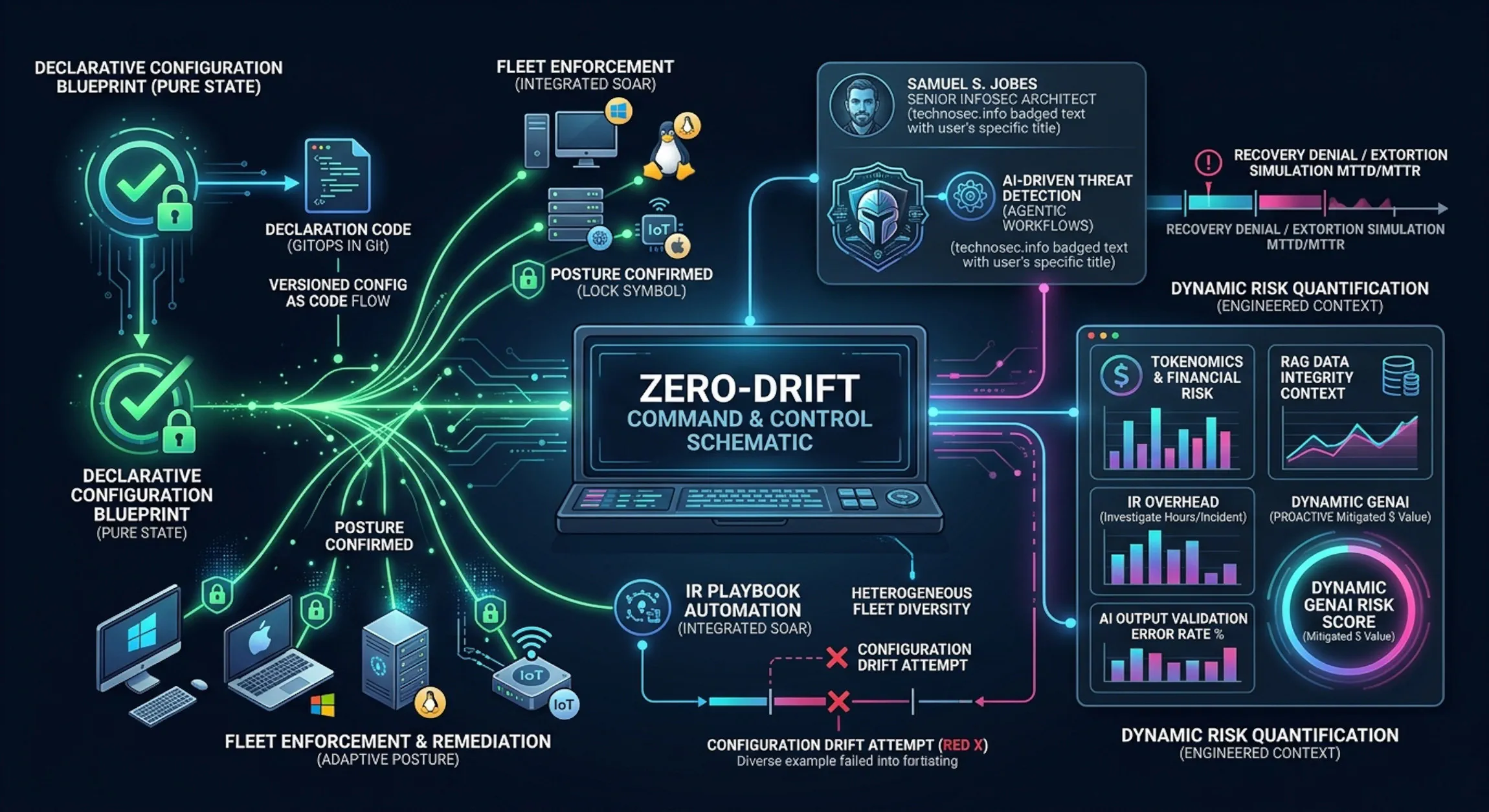
Executive Summary
In today’s hyper-distributed digital ecosystem, the corporate network perimeter has dissolved. The endpoint is the new perimeter. For cybersecurity professionals, maintaining a secure posture across a Heterogeneous Fleet—which often includes multiple versions of Windows, numerous Linux distributions, and macOS devices—is one of the most significant architectural and operational challenges. A core solution to this pervasive problem lies in establishing Host Hardening standards and, more importantly, implementing a process of Engineering Zero-Drift Endpoint Architecture. This architectural approach demands that systems maintain a declared, immutable secure state, where any unauthorized change (drift) is automatically detected, alerted, and ideally, remediated. This article provides a technical roadmap for moving from a reactive, chaotic security posture to a proactive, resilient Zero-Drift environment.
The Heterogeneous Dilemma
The reality for nearly every medium-to-large enterprise is a heterogeneous fleet. This diversity is driven by business needs, legacy application requirements, and the “bring your own device” (BYOD) model. This lack of uniformity creates a massive, fractured attack surface. A security control that works on Windows Server 2022 might be inapplicable on Ubuntu 22.04, and a configuration change that secures macOS may have no effect on a Debian-based IoT device.
Without a centralized strategy, security operations are forced into a fragmented approach:
- Patch Fragmentation: Differing patch cycles and package managers (APT, YUM, MSI).
- Configuration Drift: Local administrators making “one-off” changes, or software updates altering critical settings. This drift is invisible without continuous monitoring.
- Inconsistent Tooling: Security, Configuration Management (CM), and Endpoint Detection and Response (EDR) tools may not have feature parity across all operating systems.
- Skill Gaps: Operations teams need specialized knowledge across the entire technology stack.
This fragmented, reactive model is unsustainable. The solution is not to eliminate fleet diversity, but to engineer consistency through a standardized, Zero-Drift architectural model.
Defining Zero-Drift Endpoint Architecture
A “Zero-Drift” architecture is a declarative systems management model. It forces systems to operate in a known-good, secure, and compliant state. The “Zero-Drift” concept means that the endpoint’s configuration—its registry keys, file system permissions, active services, patch levels, and installed applications—exactly matches a centrally defined and versioned configuration policy.
Reactive vs. Proactive: The Architectural Shift
| Attribute | Reactive Fleet Management (Current State) | Engineered Zero-Drift Architecture (Target State) |
|---|---|---|
| System State | Implicit, often unknown, and in flux. | Explicit, declared, and immutable. |
| Change Control | Ad-hoc, often manual, and difficult to audit. | Centrally controlled, automated, and versioned (Git). |
| Detection of Change | Reactive, based on alerts from logs or EDR (after the fact). | Proactive and near real-time, based on continuous file integrity and configuration checks. |
| Remediation | Reactive, manual, or scripted “one-off” fixes. | Automated; the system pulls or is pushed back to the declared state. |
| Visibility | Fragmented; requires logging into multiple systems or tools. | Centralized dashboard, a single plane of glass. |
| Security Posture | Brittle; highly susceptible to the first compromise. | Resilient; designed to detect and withstand attacks. |
Engineered Zero-Drift architecture is fundamentally about changing the unit of systems management from “maintaining state” to “redeploying state.” The endpoint itself becomes, conceptually, part of an immutable infrastructure pipeline.
Pillars of a Heterogeneous Hardening Standard
A hardening standard is not a checklist; it’s a living policy framework. The first step is to select a foundation, with the Center for Internet Security (CIS) Benchmarks being the enterprise gold standard. However, a standardized policy must be tailored for the heterogeneous environment.
OS-Specific Hardening Fundamentals
While the overarching goals are the same (reduce the attack surface), the implementation requires OS-specific expertise:
-
Windows (Server and Workstation):
-
Group Policy Objects (GPOs): Centralized control over thousands of security settings.
-
Registry Hardening: Securing critical registry keys and values.
-
AppLocker/Windows Defender Application Control (WDAC): Robust application whitelisting.
-
Securing Local Accounts: Implementing Local Administrator Password Solution (LAPS).
-
Firewall: Enforcing outbound and inbound rules.
-
Services: Disabling unnecessary services.
-
Linux (Multiple Distributions):
-
SSH (sshd_config): Enforcing key-based authentication, disabling root login.
-
User/Group Management: Least privilege access control (/etc/passwd, /etc/shadow, /etc/sudoers).
-
Network Security: Implementing local host firewalls (ufw, firewalld, iptables).
-
Logging and Auditing: (auditd, rsyslog, journald).
-
System Services: Disabling unused services via systemctl.
-
Hardening Tools: (e.g., Lynis).
-
SELinux/AppArmor: Implementing Mandatory Access Control (MAC).
-
macOS:
-
Mobile Device Management (MDM): Essential for remote configuration enforcement.
-
System Integrity Protection (SIP): Verifying its continuous enforcement.
-
Gatekeeper and XProtect: Proper configuration.
-
Firewall: Inbound and outbound rules.
-
Logging: (Unified Logging System).
Implementation Strategy: A Phased Approach
Implementing this architecture is a major undertaking that must be phased to avoid critical service disruptions.
Phase 1: Baseline and Assess
The first phase is about establishing visibility. Do not attempt to enforce anything yet.
- Define Scope: Identify the critical assets, operating systems, and versions.
- Establish Baselines: Create a standardized configuration policy (based on CIS or other standards) for each major OS group. Store these policies in a version control system (Git) as “Configuration as Code” (CaC).
- Implement Monitoring: Deploy agents or use agentless tools to continuously compare the current state of endpoints against the CaC baselines.
- Analyze and Visualize: Centralize this data into a dashboard to visualize the “drift quotient” of the fleet.
#### Phase 2: Implement and Enforce
This is the central engineering phase where configuration management (CM) becomes a security enforcement tool.
- Select a Configuration Management Tool: For heterogeneous environments, modern CM tools (Ansible, Puppet, Chef, Salt) or MDM (Jamf, Intune, Kandji) are required. These are used to enforce the desired state.
- Implement Gradually: Start with low-risk changes (e.g., SSH hardening, disabling unused services) on a pilot group.
- Automate Patch Management: Ensure all systems pull updates (from internal repos or trusted mirrors) according to a declared patch policy.
- Implement Whitelisting: Deploy application controls (e.g., AppLocker, AppArmor) in “Audit Only” mode initially to build a comprehensive whitelist.
#### Phase 3: Monitor and Maintain
This phase moves the focus from implementation to operational continuous compliance.
- Continuous Compliance Monitoring: Use automated tools (e.g., OpenSCAP, specialized security/compliance monitoring platforms) for regular, automated scans.
- File Integrity Monitoring (FIM): Implement FIM (e.g., Wazuh, OSSEC) for near real-time alerts on unauthorized changes to critical files and system paths.
- Alerting and Triage: Integrate compliance alerts into existing Security Information and Event Management (SIEM) and Security Orchestration, Automation, and Response (SOAR) workflows.
- Regular Policy Review: The hardening policies themselves are code and must undergo regular review, testing, and Git-based PR workflows.
Remediation and Drift Control
The ultimate success of a Zero-Drift architecture is its ability to handle drift.
- Alerting vs. Action: For most systems, start by alerting on drift. Manual review is often required initially to distinguish legitimate operational changes from malicious activity or accidental drift.
- Automated Redeployment: As confidence increases, the ideal model is to use SOAR playbooks or the CM tool’s inherent capabilities (e.g., Ansible “pull” or Puppet/Chef agents) to automatically enforce the declared state and redeploy configuration if unauthorized drift is detected.
- Concept of Immutable State: The goal is to make any change (including legitimate updates) go through the centralized pipeline (CaC in Git) rather than being applied directly to the endpoint. The pipeline then handles the managed, version-controlled redeployment of the state.
Overcoming Operational Challenges
While the security benefits are immense, the operational impact must be carefully managed.
- Legacy Systems: Engineering state for legacy OS (e.g., Windows 7, older Linux distros) is complex and often requires accepting some level of drift. Isolation and microsegmentation should be used in conjunction.
- Tooling Parity: It is rare for a single tool to offer 100% parity across all operating systems. Security operations may need a “best-of-breed” approach, requiring a centralized data layer for visibility.
- Culture and Workflow: This strategy requires a shift from traditional IT operations. DevSecOps principles, where system administrators treat configurations as code, must be embraced.
- Exceptions and legitimate drift: There will always be a need for temporary, authorized changes. This “legitimate drift” must be handled through a formalized, time-limited, and audited workflow.
Conclusion: Towards a Resilient Future
Engineering Zero-Drift Endpoint Architecture across a Heterogeneous Fleet is a strategic necessity for any modern enterprise. It is a multi-year engineering and cultural transformation, but the results—a significantly reduced attack surface, near real-time visibility into unauthorized changes, and a robust, resilient security posture—are invaluable. By adopting a declarative, managed-state architecture and treating “Host Hardening” as an engineered process rather than a static checklist, organizations can move beyond a brittle, reactive security model towards a future where their systems are secure, stable, and designed to withstand the inevitable challenges of the modern threat landscape.