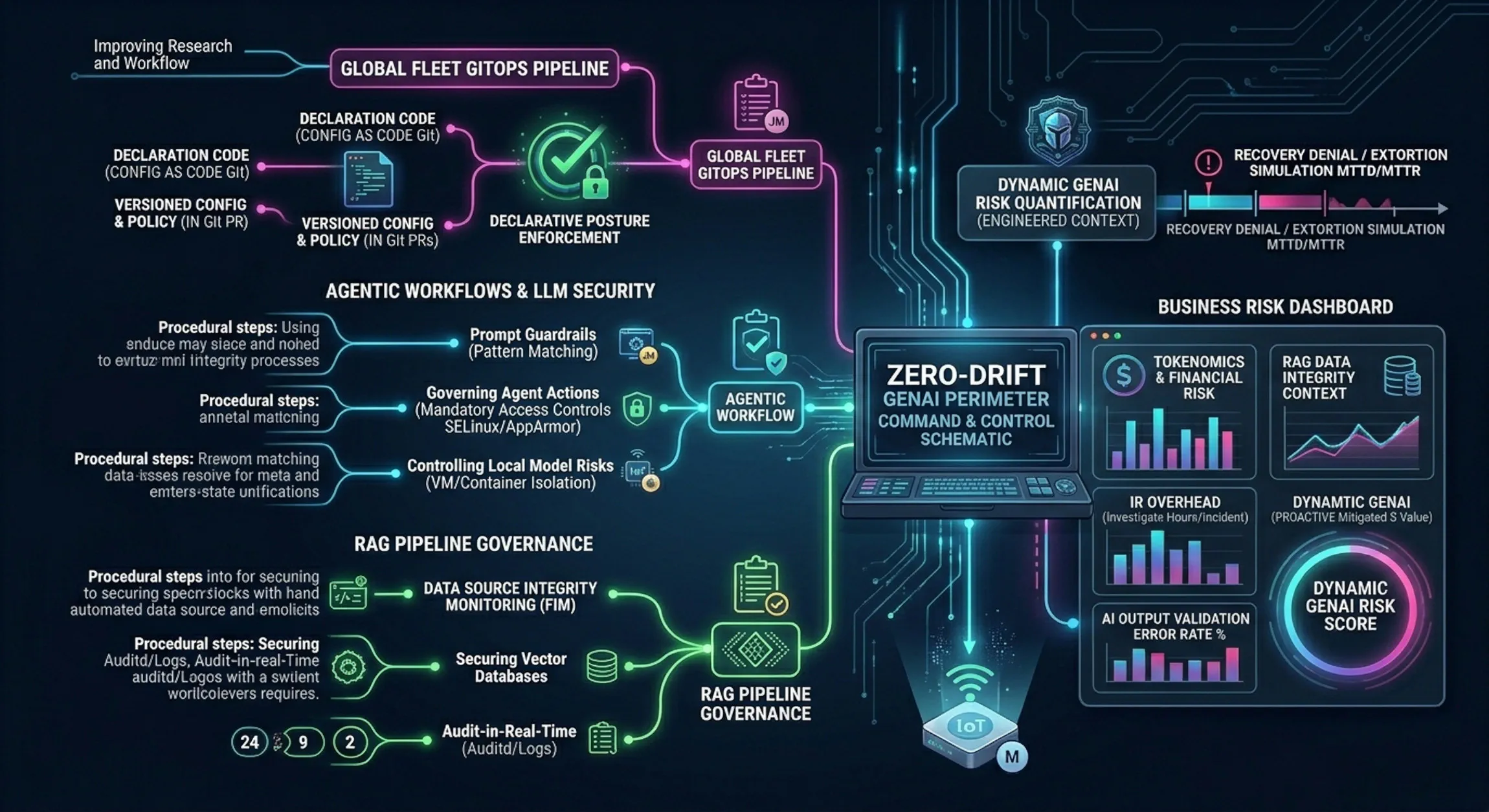
Executive Summary
The perimeter has dissolved. The rapid, business-enabled adoption of Generative AI (GenAI), from local Large Language Models (LLMs) running on developer endpoints to enterprise RAG pipelines, has created a paradigm shift in the modern enterprise. Traditional perimeter security controls, focused on inbound data and application interfaces, are insufficient to govern the complex, emerging exploit chains targeting GenAI infrastructure. For security architects, especially those with decades of deep experience in secure infrastructure and threat detection, this is not just about patching a new application; it is about engineering a multi-layered, resilient defense. This engineered approach must focus on two critical pillars: adapting endpoint posture to include GenAI-specific governance and, equally crucially, quantifying business risk using a measurable framework.
Introduction: The Vanishing GenAI Perimeter
As a Senior Information Security Architect and Incident Response Lead with over 20 years of experience, I view the current rapid adoption of GenAI as both a significant business enablement tool and a unprecedented expansion of the threat landscape. The perimeter is no longer just a set of physical firewalls or cloud security groups; it now extends to the very endpoints where AI-driven agents interact with sensitive corporate data.
From an architectural standpoint, the traditional perimeter-based security model fails when GenAI is introduced. Legitimate users are now, conceptually, part of the perimeter, and their actions can have profound and unexpected consequences. This architectural dilemma is fueled by several factors:
- Divergent Data Flows: Traditional security governs static data; GenAI governs the dynamic flow of generated, and often sensitive, information.
- Emerging Exploit Lineages: Attacks such as prompt injection, training data poisoning, and model inversion are distinct lineages that require engineered, pattern-based mitigations, not just static CVE scanning.
- Heterogeneous Adoption: A standard fleet may include multiple OSs and diverse AI agent technologies, leading to fragmented security control parity.
- Operationalization: Security teams must move from generic “data breach risk” to quantifiable, actionable metrics, integrating GenAI risk management into existing Security Operations and Incident Response workflows.
This article provides a blueprint for moving from a reactive “patch everything” mentality to an engineered, zero-drift model for GenAI perimeter defense.
Pillar 1: Adapting Endpoint Posture for the GenAI Age
The endpoint is now the first line of defense in the GenAI perimeter. To establish a secure foundation, we must move beyond traditional EDR and device health checks. The posture must be adapted to govern the entire life cycle of AI-agent interaction.
Zero-Drift Agentic Workflows
My professional interest in integrating AI-based security solutions includes the concept of agentic security workflows. The endpoint must operate under a declarative, managed-state architecture. The configuration of all AI-related software—from locally running Ollama or Llama 3 models (with 70B+ parameters) to Gitea for managing internal configuration code—must match a version-controlled, immutable state. Any unauthorized change, or configuration drift, must be automatically detected, alerted, and preferably, remediated. This applies to:
- Enforcing the Declared State: Using modern configuration management tools (e.g., Ansible, Puppet) to enforce security baselines as “configuration as code” in Git.
- Immutable AI Agents: The GenAI agents themselves, and their underlying Python environments (e.g., using Docker or Conda/Venv), must be treated as immutable components within a secured pipeline. Updates are pushed by redeploying the state, not modifying a running system.
Governing “Tokenomics” and Agent Capabilities
Traditional data egress controls cannot govern a GenAI prompt interaction. We must implement GenAI-specific guardrails:
- Enforcing Prompt Guardrails: Implementing client-side agents that intercept and sanitize user prompts on the endpoint. This agent must use advanced pattern matching to block sensitive data (e.g., API keys, customer PII) from ever leaving the endpoint.
- Governing Agent Actions: For endpoints managing complex agents (e.g., Gemini Enterprise Agent platforms, autonomous coding agents), the security posture must govern their permitted actions. Use mandatory access controls (MAC) like SELinux, AppArmor, or specific agent governance tools to limit the files, network connections, and system processes an AI agent can access.
- Controlling Local Model Risks: For large local models, ensure strict isolation from other endpoint data. Use virtual machines (like Debian VMs on Proxmox labs) or secure containers to prevent a compromised AI model from pivoting into critical user data.
Securing the RAG Pipeline on the Endpoint
As GenAI adoption moves to Retrieval-Augmented Generation (RAG) pipelines, the endpoint becomes a major aggregation point for data. Governing RAG on the endpoint requires an engineered approach:
- Data Integrity Monitoring: Implement robust file integrity monitoring (FIM) for the local knowledge bases being ingested into RAG pipelines. Alert on any unauthorized modification to the source books or journals.
- Securing Vector Databases: Implement strong local access controls and, where feasible, encryption for local vector stores.
- Audit-in-Real-Time: Use auditing tools (e.g., auditd, unified logging) to log all data access and prompt-response pairs, facilitating incident response and threat hunting within AI-driven workflows.
Pillar 2: Quantifying Business Risk – A Senior Architect’s Blueprint
The most significant challenge for cybersecurity professionals today is not just identifying risk, but quantifying it in business-relevant terms. For a senior architectural audience, a successful GenAI security program must deliver a measurable reduction in quantifiable risk.
Dynamic Risk Scoring Re-imagined
A single, static risk score is brittle. Our proposed “Engineered Risk Context” combines traditional CVSS severity, asset criticality, global threat intelligence context, and validated exploit status. For GenAI, we must expand this framework:
GenAI Dynamic Risk Score = (CVSS Severity) x (Asset Criticality) x (Tokenomic Risk) x (RAG Data Integrity Context) x (Validated Exploit Status)
By adding these GenAI-specific dimensions, we ensure that remediation efforts are prioritized against the highest real-world business risk.
A Metric-Driven Framework for Risk Quantification
As an engineer and incident responder, I prioritize highly structured, scannable responses and ground my risk management in measurable data. Here is a blueprint for a metric-driven, structured risk framework:
1. Tokenomics and Financial Risk Quantification
-
Metric 1.1: Token Velocity and Burn Rate. Track the average and peak token usage. An engineered posture alert can identify anomalies that suggest a prompt injection attack (causing model hallucinations and massive token burn) or a “wallet draining” style denial-of-service.
-
Quantified Impact: $ USD per anomalous event / $ USD projected annual excess cost.
-
Metric 1.2: Model Selection and Cost Variance. Monitor if endpoints are unnecessarily using larger, more expensive models (e.g., Qwen3-Coder 70B instead of 8B) for simple tasks.
-
Quantified Impact: $ USD efficiency gain / $ USD projected savings by right-sizing model use.
2. Data Integrity and Business Context Risk (RAG-Focus)
-
Metric 2.1: RAG Input Integrity Check Failures. Track the number of automated integrity violations detected for internal data sources ingested by RAG pipelines.
-
Quantified Impact: Number of unauthorized data source modifications / projected cost of re-verification and rollback.
-
Metric 2.2: AI-Generated Output Validation Accuracy. Measure the rate at which human-in-the-loop validation identifies critical errors (hallucinations or data poisoning) in AI-generated output.
-
Quantified Impact: Error rate % / Projected cost of business decisions based on poisoned output.
3. Incident Response and Extortion Risk Quantification
-
Metric 3.1: Extortion and Recovery Denial Simulation Time. Regularly simulate modern extortion tactics that target GenAI RAG sources. Quantify the Mean Time to Detect (MTTD) and Mean Time to Respond (MTTR).
-
Quantified Impact: Reduction in projected restoration time / Proactive mitigation cost compared to potential extortion demand.
-
Metric 3.2: AI-Specific Incident Response Overhead. Track the additional time and resources required to investigate GenAI-related security events compared to traditional endpoint security incidents.
-
Quantified Impact: Investigate hours per GenAI incident / Total IR budget allocation for GenAI threat handling.
Conclusion: Towards an Engineered, Resilient Defense
Securing the GenAI perimeter is not a static project; it is a long-term architectural transformation. By treating “Host Hardening” as an engineered process, embracing “Configuration-as-Code” for AI environments, and moving to a proactive “Tokenomics-aware” risk framework, organizations can move beyond a brittle, reactive security model.
This structured approach, drawing on decades of experience in secure architecture and incident response, is critical for building systems that are not just secure, but resilient—designed to enable business innovation while proactively identifying, measuring, and mitigating the inevitable security and financial risks of the modern AI threat landscape. A force multiplier for the enterprise is a secure, engineered perimeter designed for business enablement and built for the future of AI.