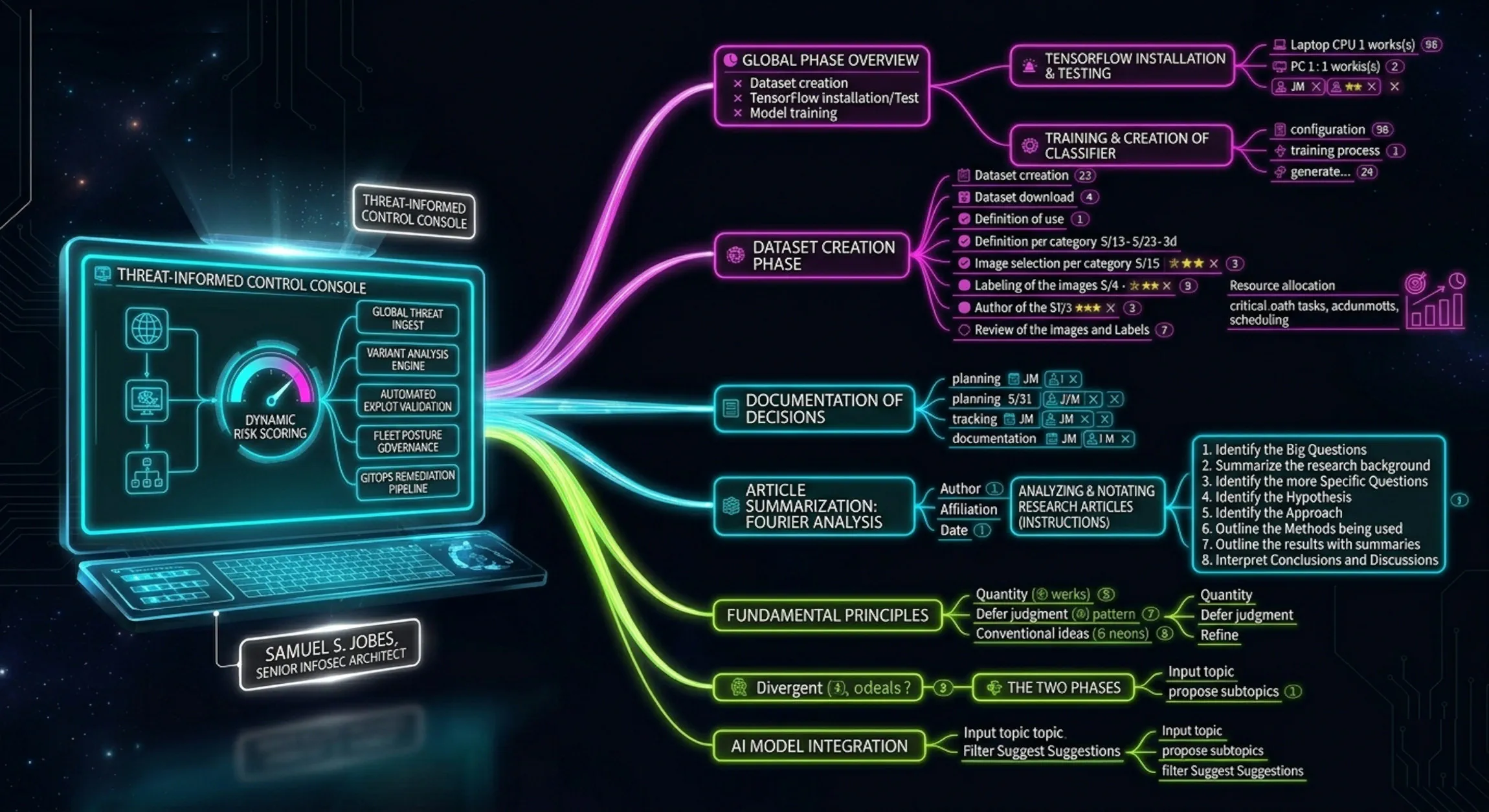
Executive Summary
Traditional vulnerability management is in crisis. The volume of new CVEs, combined with sophisticated threat actors and diverse, fractured enterprise fleets, has created an unsustainable operational burden. Security teams are drowning in high-priority alerts, yet compromises continue. This article provides a technical roadmap for moving from a reactive “patch-everything” model to a proactive, resilient strategy: Threat-Informed Vulnerability Management (TIVM). This approach prioritizes remediation based on actual threat intelligence, dynamic exploit validation, and a focus on addressable vulnerability variants. By engineering TIVM into the security architecture, organizations can move from measuring patch compliance to a truer metric of security resilience.
Introduction: The Limitations of Reactive Scanning
For decades, vulnerability management has been dominated by a single workflow: a scanner identifies a missing patch or a misconfiguration, assigns it a CVSS score, and generates a ticket for IT to patch. This model is built on two implicit, and now incorrect, assumptions:
- The Scanner is Always Right: That a vulnerability’s presence is equivalent to its exploitability.
- All Patches are equal: That a CVSS score of 9.0 is automatically a more significant risk than a CVSS score of 7.0, regardless of context.
In a heterogeneous fleet, a standard vulnerability scan is often too noisy. It forces operations teams to chase after thousands of high-and-critical-severity vulnerabilities, creating patch fatigue and operational fragmentation. Meanwhile, threat actors are not scanning for every CVE. They are looking for specific, highly effective variants that they know will work across their targets. The traditional model is a reactive, un-winnable “wack-a-mole.” A shift is required.
The Philosophy of Threat-Informed Vulnerability Management
A “threat-informed” approach re-frames vulnerability management from a static asset management problem to a dynamic security engineering challenge. The core question is no longer “What are we vulnerable to?” but “What can an attacker actually do, and how do we engineer a defense against that specific exploit chain?”
Proactive vs. Reactive: A Cultural and Architectural Shift
| Attribute | Reactive Patch-Everything (Current State) | Engineered TIVM Architecture (Target State) |
|---|---|---|
| Data Source | Local configuration scans and asset inventory. | Deep asset context + Real-time global threat intelligence. |
| Vulnerability Focus | All identified CVEs, prioritized by CVSS only. | High-value variants and validated exploit paths. |
| Change Control | Ad-hoc, often manual, and difficult to audit. | Centrally controlled, automated, and versioned. |
| Visibility | Brittle; highly susceptible to the first compromise. | Resilient; designed to detect and withstand attacks. |
| Remediation | Reactive, manual, or scripted “one-off” fixes. | Automated; the system pulls or is pushed back to the declared state. |
| Change Control | Proactive and near real-time, based on continuous checks. | Reactive, based on alerts from logs or EDR (after the fact). |
TIVM is fundamentally about prioritizing your most valuable resources—remediation efforts—against the highest real risk. The solution is not to patching faster, but to patch smarter.
Pillar 1: Variant Analysis: Addressing Vulnerability Lineages
Variant analysis is the proactive security engineering capability. Instead of looking for a specific CVE, variant analysis looks for known vulnerability patterns that are common across multiple code bases or operating systems.
A classic example of a variant is a cross-site scripting (XSS) vulnerability. If a flaw is found in the way a web application handles user input in one form, a security engineer performing variant analysis would immediately look for all other user input fields in that application, or related applications, and search for the same pattern.
The Process of Variant Analysis at Scale
Performing variant analysis at scale—across a heterogeneous fleet and thousands of applications—requires a sophisticated data engineering pipeline.
- Identify a Known Flaw (Root Cause): Start with a specific, validated vulnerability.
- Deconstruct the Pattern: Understand the underlying technical flaw. Was it a misconfigured registry key? A missing permission on a specific binary? A failure to validate user input? Store this pattern as “configuration-as-code” or a security policy.
- Deploy Pattern Matching Automation: Create automated scripts or policies (e.g., in Ansible, GPOs, or specialized security orchestration platforms) to search your entire fleet for this pattern, not just the single asset.
- Visualize and Alert: Centralize the results. This data is invaluable for proactively identifying new critical systems that may be at risk from a whole new lineage of an attack, even before a specific CVE is assigned.
The Business Value of Scalable Variant Analysis
The business case for variant analysis is operational efficiency and a massive reduction in future risk. If a organization can remediate a single vulnerability pattern, it has proactively blocked countless future CVEs that would be based on that same flaw. It transforms security from a manual wack-a-mole to a force multiplier.
Pillar 2: Exploit Validation: Beyond the “Vulnerable” Label
The “vulnerable” label from a scanner is a point-in-time configuration check. Exploit validation is a dynamic confirmation of actual risk. It answers the question: “Okay, the system is vulnerable, but under our specific configuration, can it actually be exploited by an attacker?”
#### Validating Exploitability vs. Mere Vulnerability
There is a significant gap between “vulnerable” and “exploitable.” Many factors can make a system un-exploitable even if it has a severe vulnerability:
- Network Microsegmentation: The asset is isolated from the network segment where an attacker would be present.
- Disabled Services: The vulnerable service is configured, but not active.
- Least Privilege: The service is running as a non-privileged user.
- Security Controls: An EDR or an IPS is actively blocking the exploit pattern.
Continuous, Automatic, and Continuous Validation (CAAV)
A point-in-time exploit validation exercise is a reactive measure. TIVM demands a proactive, continuous approach. This requires automated exploitation simulation tools and a robust orchestration layer.
- Orchestration Trigger: Integrate exploit validation into the automated data pipeline. When a scanner identifies a specific high-severity vulnerability, it should automatically trigger a validation workflow.
- Simulated Exploitation: Deploy automated tools (e.g., specialized vulnerability validation platforms, or SOAR playbooks integrating existing security tools) to attempt to safely exploit the vulnerability in a non-disruptive way.
- Analyze the Outcome: The output is a binary result: Exploit Succeeded or Exploit Failed.
- Failed Exploitation: This is a force-multiplier result. The system is not immediately exploitable. Patch fatigue is reduced. IT has more time to test the patch before deploying it.
- Succeeded Exploitation: This is a critical-severity, immediate-action alert. There is no doubt about the risk. The security team must work with IT to remediate immediately, potentially using microsegmentation or an IPS rule as an interim compensating control.
Operationalizing: TIVM as a Data and Workflow Problem
The biggest obstacle to TIVM is operational integration. It requires breaking down the traditional siloes between threat intelligence, security operations, and the IT operations teams who perform remediation.
Creating the Unified Data Pipeline
TIVM is fundamentally a data engineering challenge. A centralized dashboard or data layer is needed to ingest, normalize, and analyze data from dozens of disparate sources.
- Internal Data: CMDB, configuration scans, asset criticality tags.
- Global Threat Intelligence: CVE details, dark web chatter, known exploits.
- Validation Data: Exploit succeeded/failed results.
- Remediation Data: Patch status, configuration state from the configuration management (CM) system.
#### Risk Scoring Re-imagined: Dynamic Risk Context
In TIVM, the static CVSS score is just one input into a dynamic, multi-dimensional risk score. This new, “engineered risk context” is much more powerful.
Dynamic Risk Score = (CVSS Severity) x (Asset Criticality) x (Global Threat Context) x (Validated Exploit Status)
The resulting dynamic risk score is what prioritized remediation tickets for IT. This is how organizations ensure they are always working on their most critical, addressable real-world risk.
Integrating into Managed and SOAR Workflows
Finally, TIVM must be integrated into the existing managed workflows and SOAR playbooks.
- Vulnerability Detected: The scanner identifies a vulnerability.
- Automated Triage: SOAR playbooks are triggered. The playbook pulls in threat intelligence and queries the asset CMDB.
- Automated Exploit Validation: If the asset is critical and a PoC exists, an automated validation workflow is triggered.
- Enriched Ticket Created: The playbook creates a Jira or ServiceNow ticket that is pre-enriched with a dynamic risk score, the exact exploit proof, and the recommended remediation step.
Conclusion: Towards an Engineered, Resilient Defense
Engineering Threat-Informed Vulnerability Management is not a product; it’s a strategic, long-term capability. It is a multi-year engineering and cultural transformation, but the results—a significantly reduced attack surface, near real-time visibility into addressable risk, and a resilient security posture—are invaluable. By treating “Vulnerability Management” as an engineered process rather than a static checklist and embracing “Configuration-as-Code” for both defense and proactive variant analysis, organizations can move beyond a brittle, reactive security model. They can move towards a future where their systems are secure, stable, and designed to withstand the inevitable challenges of the modern threat landscape.