If you’ve spent any time in the trenches of enterprise architecture over the last two years, you already know the truth: the AI data center is an entirely different beast.
As information security professionals, we’ve spent the better part of the last two decades optimizing perimeter defenses, deploying inline next-generation firewalls, and tuning intrusion prevention systems. But in 2026, as organizations spin up massive, ultra-dense GPU clusters to train trillion-parameter Large Language Models (LLMs) and deploy real-time Retrieval-Augmented Generation (RAG) pipelines, the old blueprints are breaking down.
You simply cannot push 800Gbps to 1.6Tbps of East-West RDMA traffic through a traditional choke-point firewall without melting the appliance—or worse, bottlenecking the multi-million-dollar GPUs your board just approved.
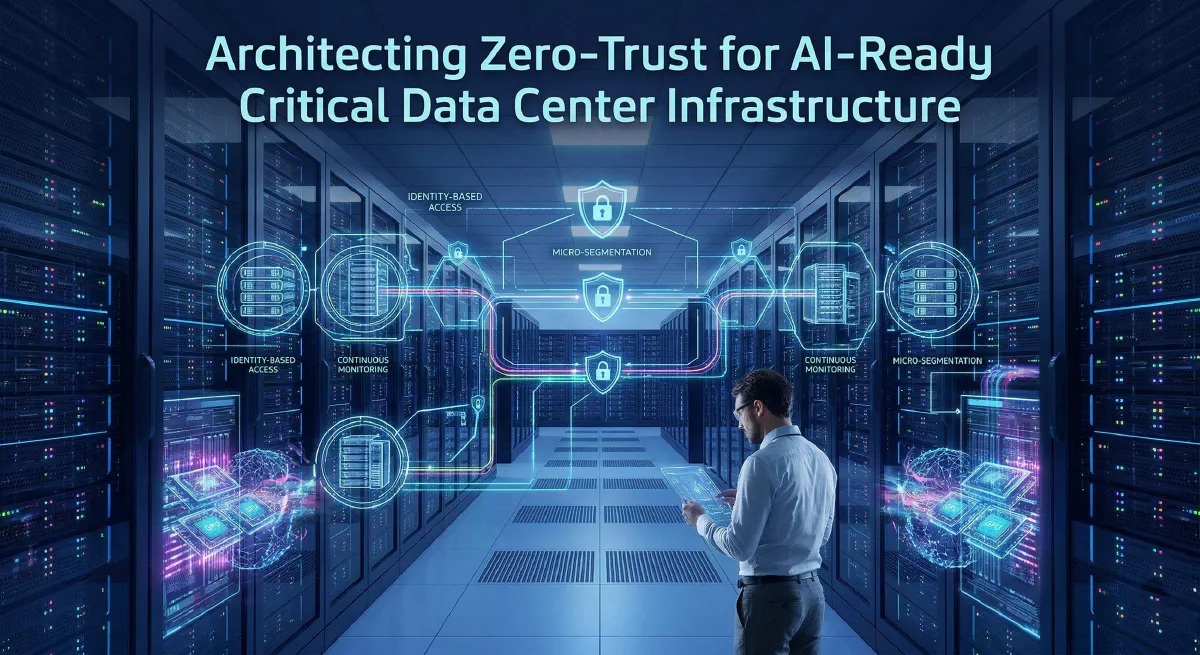
Securing the AI-ready data center requires a fundamental paradigm shift. We must architect Zero Trust at the silicon and fabric layers. In this article, I will break down the critical pillars for designing a Zero-Trust architecture specifically engineered for the high-performance, critical infrastructure demands of modern AI workloads.
The AI Data Center Paradox: Blindness by Design
To understand why we need a new architecture, we have to look at how AI clusters communicate. In a traditional environment, a web server talks to a database, passing through the CPU, the operating system’s network stack, and eventually a hypervisor or container runtime. Traditional security agents live in these layers.
In an AI cluster utilizing technologies like NVIDIA GPUDirect RDMA (Remote Direct Memory Access) or RoCEv2 (RDMA over Converged Ethernet), GPUs bypass the CPU and the host operating system entirely. They read and write directly to the memory of other GPUs across the network fabric.
The security implication is massive: Your host-based EDR agents and kernel-level network filters are completely blind to this traffic. It is an ocean of encrypted, ultra-fast “elephant flows” that bypass traditional inspection points. If an attacker gains a foothold in one node, lateral movement across the GPU fabric is trivial unless Zero Trust is embedded directly into the infrastructure.
Here is how we build that.
Pillar 1: The DPU as the New Enforcement Boundary
If we can’t inspect the traffic at the CPU or the core switch, where do we enforce micro-segmentation? The answer lies in the Data Processing Unit (DPU) or SmartNIC.
In an AI-ready Zero Trust architecture, every compute node must be equipped with a DPU. These specialized processors offload networking, storage, and security from the host CPU. By pushing the Zero Trust enforcement boundary down to the DPU, we achieve several critical security goals:
- Wire-Speed Micro-segmentation: DPUs allow us to enforce stateful firewall rules and micro-segmentation policies at 800G+ speeds before the traffic ever hits the data center fabric.
- True Hardware Air-Gapping: The security controls run on a separate silicon domain from the host OS. Even if a threat actor compromises the hypervisor or the Linux kernel running the AI workload, they cannot tamper with the security policies enforced on the DPU.
- Offloaded Encryption: DPUs can handle MACsec or IPsec encryption for host-to-host traffic seamlessly, ensuring all East-West data is encrypted in transit without stealing precious compute cycles from the GPUs.
Pillar 2: Cryptographic Machine Identity (SPIFFE/SPIRE)
Zero Trust mandates that we authenticate and authorize every request. In the AI data center, human users rarely interact directly with the core infrastructure. Instead, millions of machine-to-machine interactions occur every second: ingestion scripts pulling from data lakes, vector databases updating, and inferencing APIs calling embedding models.
Relying on static IP addresses or long-lived API keys is a recipe for disaster. We must shift to Identity-First Security for workloads.
- Ephemeral Credentials: Implement frameworks like SPIFFE (Secure Production Identity Framework for Everyone) to issue cryptographically verifiable, short-lived identities (SVIDs) to every microservice and training job.
- Mutual TLS (mTLS): Ensure that any communication outside of the dedicated RDMA compute fabric—such as a model pulling training data from a secure storage array—is authenticated via mTLS. The storage array must verify the cryptographic identity of the requesting workload, not just its subnet.
Pillar 3: Securing the Hardware Root of Trust
AI servers are high-value targets. A state-sponsored actor or sophisticated ransomware group doesn’t just want to steal your data; they want to poison your models or establish deep persistence.
In a Zero Trust data center, “never trust, always verify” applies to the hardware itself. We must assume the supply chain is hostile and that hardware components could be compromised.
- Baseboard Management Controllers (BMCs): The BMC (or IPMI interface) is the keys to the physical kingdom. In 2026, out-of-band management networks must be rigorously isolated. Zero Trust network access (ZTNA) proxies should be required for any administrator attempting to access a BMC.
- Firmware Attestation: Implement continuous cryptographic verification of firmware. Before a node is allowed to join the high-speed AI fabric, a hardware root of trust (e.g., TPM 2.0 or specialized silicon) must attest to the integrity of the BIOS, the BMC firmware, the DPU firmware, and the GPU firmware. If the hashes don’t match known-good states, the node is isolated into a quarantine VLAN.
Pillar 4: Data Pipeline & Model Weight Protection
Data is the lifeblood of AI. The models themselves (the “weights”) are the crown jewels—often representing tens of millions of dollars in compute time and proprietary intellectual property.
Zero Trust must extend up the stack to protect the data pipeline:
- Just-In-Time (JIT) Data Access: Data scientists and MLOps engineers should not have standing, persistent access to training lakes. Implement JIT access workflows where engineers request access to specific datasets for a limited time, auto-revoked once the training run completes.
- Data Lineage and Integrity: Use cryptographic signing to verify the integrity of training data and model weights. If an attacker manages to silently alter the vector database (a classic data-poisoning attack), the pipeline should detect the signature mismatch and halt the training run.
- Continuous Threat Exposure Management (CTEM): Leverage AI to defend AI. Use machine learning-driven anomaly detection to baseline normal data access patterns. If an inference endpoint suddenly starts querying backend databases at 100x its normal volume (a potential prompt-injection exfiltration attack), the system should automatically sever the identity’s access.
The Architect’s Mandate
Building an AI-ready data center is a monumental engineering challenge. But attempting to retrofit legacy, perimeter-based security onto a massive GPU cluster is a fool’s errand. It will either cripple your performance or leave your most valuable intellectual property wide open.
As security leaders, our mandate in 2026 is clear. We must stop thinking about security as “boxes on a wire” and start embedding it directly into the silicon, the identities, and the fabric of the infrastructure itself.
By leveraging DPUs for wire-speed enforcement, establishing cryptographic machine identities, enforcing hardware-level attestation, and rigorously protecting the data pipeline, we can give our organizations the confidence to innovate at the speed of AI—without compromising the critical infrastructure that supports it.
About the Author Sam Jobes, CISA-CISSP, is a 20-year information security veteran specializing in enterprise security architecture, GRC automation, and building scalable infosec programs for high-growth technology companies.