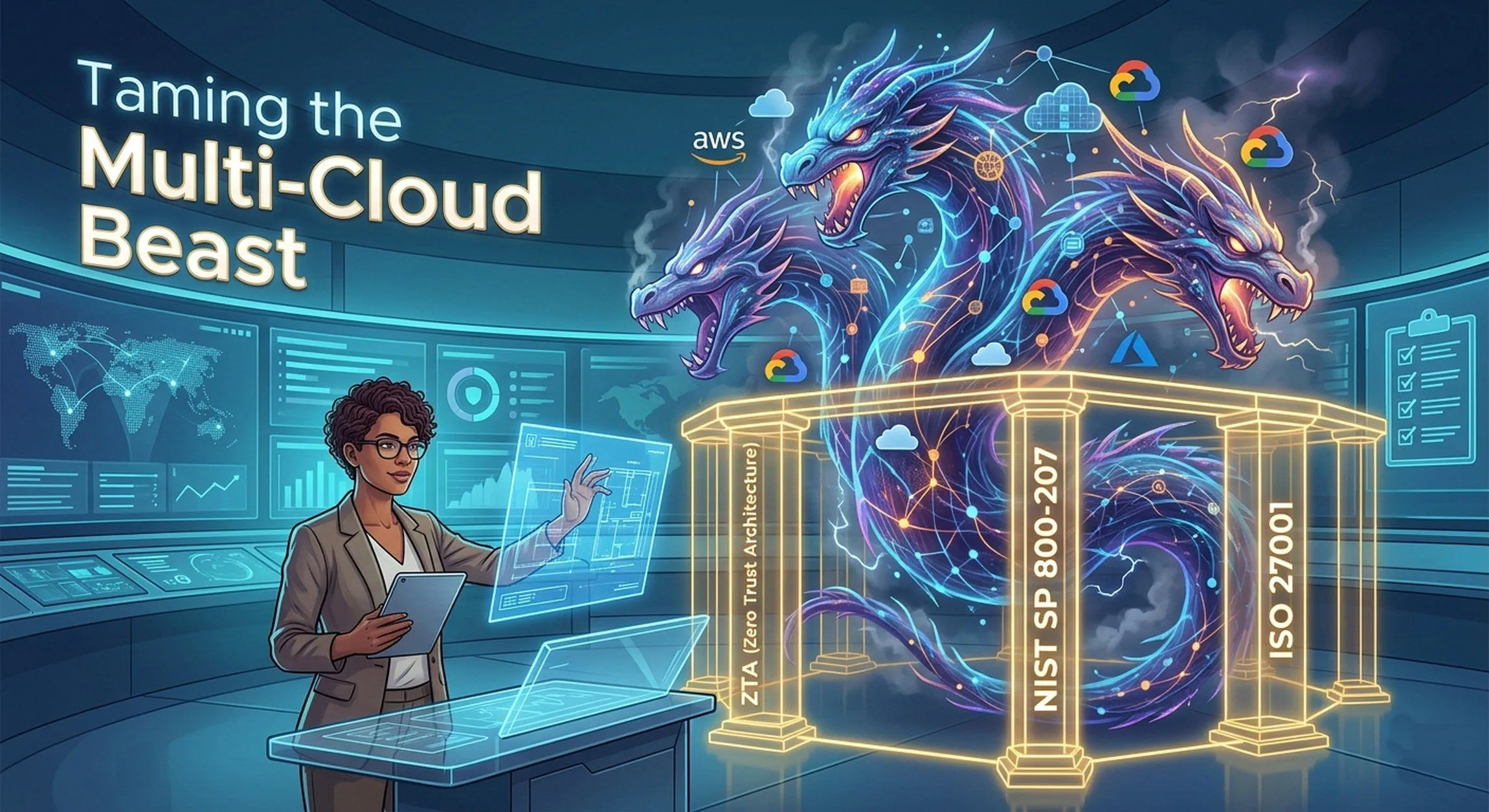
Taming the Multi-Cloud Beast
The mandate for modern enterprise IT is clear: agility requires a multi-cloud strategy. Leveraging the unique strengths of AWS, Azure, and GCP, alongside varied SaaS providers, is no longer a luxury-it’s a competitive necessity.
However, this agility comes with a terrifying side effect: a massive, fragmented attack surface. In a multi-cloud environment, the traditional network perimeter doesn’t just crack; it dissolves entirely. Organizations face a chaotic reality of inconsistent security tools, identity federation nightmares, visibility gaps, and policy enforcement that varies from one provider to the next.
To transform this chaos into a resilient, compliant ecosystem, architects cannot rely on native cloud tools alone. You need a holistic strategy that synthesizes three distinct disciplines:
- The Operational Model: Zero Trust Architecture (ZTA).
- The Conceptual Blueprint: NIST SP 800-207.
- The Governance Framework: ISO/IEC 27001.
Here is how to architect multi-cloud security by aligning these three pillars.
Pillar 1: The Tactical Blueprint - NIST SP 800-207 (Zero Trust)
NIST SP 800-207 provides the abstract principles and logical components for ZTA. It moves defenses away from static, network-based perimeters and focuses relentlessly on users, assets, and resources. Trust is never implied; it must be continuously verified.
When designing your multi-cloud architecture, every engineering decision must be validated against the core ZTA tenets.
Applying NIST ZTA Tenets to Multi-Cloud
| NIST ZTA Tenet | Multi-Cloud Application |
|---|---|
| 1. All data sources and computing services are resources. | Your scope must include VMs in AWS, Kubernetes clusters in GCP, SaaS apps (like Microsoft 365), storage buckets, and APIs across all providers. Nothing is excluded. |
| — | — |
| 2. Secure all communication, regardless of network location. | Trust is not implied by being “inside” a VPC or VNET. Every inter-service and user-to-service call must be encrypted (e.g., Mutual TLS) and authenticated. |
| — | — |
| 3. Access is granted on a per-session basis with least privilege. | Use temporary credentials and Just-in-Time (JIT) access for administrative tasks. Authentication to one cloud application should not provide automated access to another cloud’s resources. |
| — | — |
| 4. Access determined by dynamic policy. | Access decisions must correlate multiple data points: user identity/role, device health/posture, location, and behavioral analytics. (e.g., A developer normally on a corporate laptop in the US trying to download code at 2 AM from a generic device in another country should be blocked.) |
| — | — |
| 5. Monitor integrity and posture of assets. | Continuously scan for configuration drift and vulnerabilities across AWS, Azure, and GCP. Assets that fall out of compliance lose access to critical resources immediately. |
| — | — |
| 6. Collection information to improve security. | Centralize logging from all providers into a single SIEM. Use this telemetry to refine access policies and automate threat response. |
| — | — |
Pillar 2: The Governance Framework - ISO 27001 Alignment
While ZTA tells you how to secure the technology, ISO 27001 tells you why you are doing it and how to prove it is effective. ISO 27001 does not mandate specific technologies; instead, it requires an organization to establish an Information Security Management System (ISMS) to manage risks.
ZTA acts as a powerful set of controls that satisfy high-level ISO 27001 requirements. Your architectural decisions need to be documented and proven within this ISMS structure.
Aligning with ISO 27001 Standard Clauses
Auditors in a multi-cloud environment will expect to see how your architecture map to these key clauses:
- Clause 6.1: Actions to Address Risks and Opportunities. Traditional perimeter defenses are no longer acceptable compensating controls in multi-cloud. Your risk treatment plan must identify ZTA components (e.g., ZTNA, micro-segmentation) to treat risks related to unauthorized access and lateral movement.
- Clause 7.5: Documented Information. You must maintain a “master risk register” and unified control documentation that covers all cloud environments. You must prove that controls (like encryption schemes) are applied consistently across AWS and Azure.
- Clause 8.1: Operational Planning and Control. Integrate security gates directly into your CI/CD pipelines across clouds. Perform continuous configuration scanning to prevent drift and enforce secure baselines.
Mapping ZTA to ISO 27001 Annex A Controls (2022 Update)
The principles of “never trust, always verify” map directly to several technological and organizational themes within Annex A.
| ISO 27001 Annex A Control Theme | ZTA Principle Alignment |
|---|---|
| A.5 Organizational Controls (e.g., A.5.15 Access Control) | Corresponds to least privilege and per-session access. Requires clear, documented policies for who accesses what and why, enforced consistently across providers. |
| — | — |
| A.8 People Controls (e.g., A.8.3 Information Security Awareness) | ZTA changes user experience (e.g., continuous MFA). Training must help users understand the “never trust” mindset to avoid resistance to new security friction. |
| — | — |
| A.10 Technological Controls (e.g., A.10.1 Access Rights) | Central use of strong Identity and Access Management (IAM), MFA, and federated identity to enforce dynamic access policies. |
| — | — |
| A.10 Technological Controls (e.g., A.10.33 DLP, A.10.33 Data Masking) | Requires ubiquitous encryption of data at rest and in transit across all clouds. Uses micro-segmentation to “sandbox” applications and prevent lateral movement. |
| — | — |
Pillar 3: The Architecture Model - Integrated ZTA Components
A standard-compliant ZTA for multi-cloud requires unifying the logical planes described in NIST SP 800-207. You must move away from cloud-native silos and toward a centralized decision-making architecture.
The Logical Components
To bring this architecture to life, you must implement three primary logical components that operate above the specific cloud providers:
- Policy Engine (PE): This is the “brain.” It makes the final decision to grant, deny, or revoke access to a resource. In multi-cloud, you must strive for as few policy engines as possible to avoid silos and policy gaps. It ingests input from enterprise telemetry (SIEM, IDP, CDM) to make real-time risk assessments.
- Policy Administrator (PA): This is the “arm.” It executes the decision of the PE. It communicates with the Policy Enforcement Points to open and close communication channels and manage session credentials.
- Policy Enforcement Point (PEP): This is the “gatekeeper.” It monitors and strictly enforces authorized connections. For multi-cloud application-level access, this often involves:
- Sidecar Proxies: Deployed alongside microservices in Kubernetes (Service Mesh) to handle authentication and encryption (mTLS).
- API Gateways: Enforcing policies for external-facing APIs.
- Identity infrastructures (e.g., SPIFFE/SPIRE) to provide workload identity regardless of the underlying cloud platform.
Conclusion
Architecting multi-cloud security is not a choice between compliance and capability. By aligning Zero Trust principles (NIST SP 800-207) with standard governance (ISO 27001), you create an architecture that is simultaneously highly secure and auditable.
This alignment forces the consolidation of identity, visibility, and policy. It moves the organization away from relying on the disparate security postures of individual cloud providers and toward a unified, resilient defense strategy centered on protecting data and resources, no matter where they reside.